Does a Tunnel Wash Really Use Less Water Than Washing at Home?
A look at where driveway water goes, and what a tunnel does differently with every gallon.
October 16, 2026 · 3 min read
Washing the car in the driveway feels thrifty. A bucket, a sponge, a Saturday morning. But when people actually watch the hose, the picture changes. Water runs the whole time you're rinsing, soap trickles down the driveway into the street, and a good share of the water never touches the car at all. A tunnel wash that recovers its water works differently, and the gap is bigger than most people guess.
Where driveway water goes
Think through a typical home wash. You wet the car down, soap it, and rinse it. If the hose is running while you scrub, it's still flowing onto the concrete. Then you rinse again, and probably once more to chase streaks. Every drop of that water, along with the soap and the road grime it picked up, heads down the driveway and out toward the street. It isn't collected, it isn't cleaned, and it isn't used a second time.
That's not a criticism. It's just how a hose works. A hose delivers a lot of water fast, and unless you shut the nozzle between every step, much of it is wasted. Even careful people with a bucket and a spray nozzle use plenty once the rinsing starts.
What water reclaim means in a tunnel
A tunnel is a closed system. Water falls on the car, drains into the floor of the bay, and gets collected instead of sent away. Then it's treated and put back to work on the next car. Balboa Express Carwash uses a PurWater and PurClean water recovery system to do it.
Here's what that system does, in plain terms. The recovered water is filtered down to 5 microns, and a micron is one millionth of a meter, so the particles that get through are far too small to see. The system uses no disposable filters, which means no pile of used cartridges headed for the trash. Ozone is injected into the water to reduce the odors that reclaimed water can pick up. The result is water that's clean enough to run through the early stages of the wash again and again.
Recycled water does the heavy lifting early on, but it isn't what dries on your paint. The last pass is a reverse osmosis rinse, which removes the dissolved minerals that leave white spots when water evaporates. That's the spot free rinse that comes with Gold and Platinum. So the water that sits on your car at the end is mineral-free, not leftover rinse water. If you've ever wondered why a tunnel-washed car can look cleaner than one you rinsed with the hose, this is a big part of the answer.
The number we can stand behind
Each time you wash at a tunnel like ours instead of at your driveway, you save somewhere between 50 and 150 gallons of water. We give you a range rather than a promise because the real figure depends on how you wash at home. A quick rinse with a spray nozzle sits near the low end. A thorough wash with the hose running sits near the high end.
We'd rather not dress that up with bigger claims. The range is honest, and it's already a meaningful amount for a task you might do several times a month.
Power and chemicals
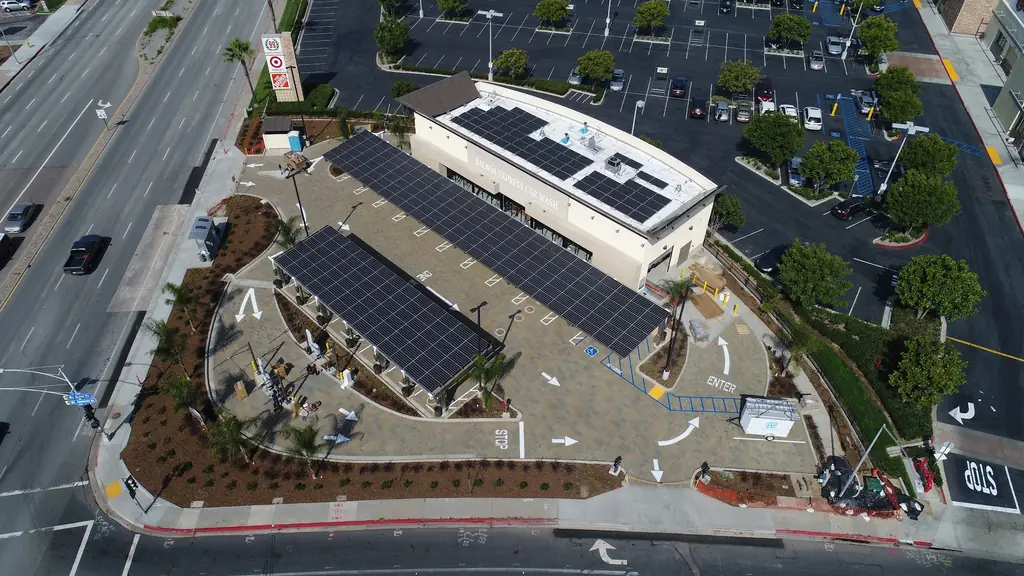
Water isn't the only resource a wash uses. This one is powered by solar. If you look at the aerial photo of the site, you can see solar panels on the building roof and canopies over the vacuum bays. The panels also help warm the wash water, and warm water loosens grime more easily than cold. The soaps and chemicals used in the wash are biodegradable.
When washing at home still makes sense
A tunnel isn't the answer to everything. If you enjoy hand detailing, or you're maintaining a delicate finish with a routine you trust, a home wash is a fine hobby. If you do wash at home, a few habits cut the waste: shut the nozzle between steps, use a bucket for the soap, and rinse in sections rather than all at once.
For the weekly or twice-monthly wash that keeps San Diego dust and coastal film off your car, though, the tunnel is the lighter option on water, and it's quicker too. You pull in, you're through in a few minutes, and the water goes back into the loop instead of down the street.
You'll find us at 6066 Balboa Avenue, open 8 AM to 8 PM daily, weather permitting. Call (858) 495-9274 if you'd like to know more about how the system works.
Balboa Express Carwash, (858) 495-9274
Call (858) 495-9274More articles
How Often Should You Wash Your Car in San Diego?
Mild weather makes cars look cleaner than they are, so here's a schedule that matches how your car actually lives.
What Is a Spot Free Rinse, and Does It Matter?
The last rinse in the tunnel decides whether your car dries clean or covered in tiny white dots.